If these pages appear anything less than perfect, your browser is probably not accepting all the html instructions; in which case you can download the necessary software from one of the following logo-links (although Netscape won't recognise the background sounds):
(Click on any picture to see it in greater detail.)
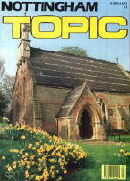
(The cover of March 1993's edition of the "Nottingham Topic".)
The Village of Bulcote
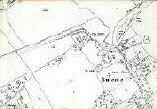
(Ordnance Survey map showing Bulcote in 1913 - before the bypass separated the church from the village.)
There was a settlement in Bulcote even before the Norman Conquest. The village derives its name from "cote" (an ancient term for a shelter) for bulls. Its location was, and still is, ideal for rearing cattle on the lush pastures of the Trent Valley. An entry in the Domesday Book tells us that the Swein family occupied the manor at the time of the Conquest and that the village's population was 132, considerably greater than that of the neighbouring village of Burton Joyce (1991 census figures show Bulcote's population had risen to 337 whilst Burton Joyce's had snowballed to 3,520).
The Mediæval Church
There is no mention of a church at Bulcote in the Domesday Book. It is thought that it was probably founded as a manorial chapel within the parish of Burton Joyce by the Sancta Maria family, who were lords of Bulcote in the thirteenth century. Records tell us that Adam Sancta Maria, who lived here in the first half of that century, gave the advowson (the right to appoint a clergyman to a living) of Holy Trinity Church, together with the lands at Bulcote, to Welbeck Abbey for "the sake of the souls of his first wife, Alice, and his son Bartholomew". It remained with Welbeck until 1349 when (together with Burton Joyce's church) it was surrendered to Shelford Priory in exchange for the advowson of Kelham. It was in documents accompanying this transaction that it was stated "the Vicar shall find at his own costs and charges one able Chaplain to celebrate Divine Service in the Chapel of Bulcote". On the dissolution of the priory in 1536 both churches were appropriated by Sir Michael Stanhope.
Whilst Burton Joyce's church is dedicated to St. Helen (the supposed daughter of "Old King Cole" and the mother of King Constantine), Bulcote's church has been dedicated to the Holy Trinity since at least the seventeenth century.
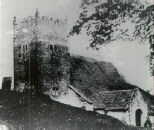
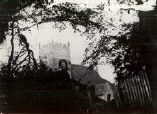
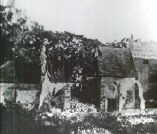
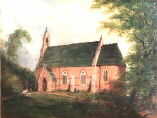
Little is known of the original, mediæval church building other than what can be seen from three photographs and an old painting displayed in the current church (as included on this page). However, from Reverend John Rolleston's records it is known that by 1860 the church was in a very poor state of repair and was closed because it was "falling down and parting in all directions".
A year later the church was sadly struck by lightning and completely destroyed. This is recorded in the 20th July 1861 edition of "The London Illustrated News" under the heading of Country News. It was reported that "a few days ago a violent thunderstorm passed over the villages of Lowdham, Carlton, etc. in Nottinghamshire, and during the storm, the electric fluid struck the parish church of Bulcote and the building fell to the ground". This event was witnessed by Miss Maria Popplewell from her upstairs drawing room at Bulcote Lodge, across the paddock to the south of the church.
The "New" Church
(Detail from the painting displayed below.)
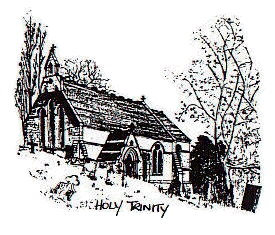
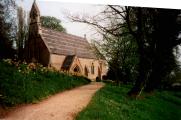
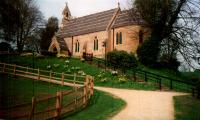
The present church was built in 1862 on the site of the earlier, collapsed one. The entire cost of the new church was financed by Colonel Egerton Leigh of Bulcote Manor, for a total of around £900. The church was essentially as seen and worshipped in today.
Points of interest:
In the south side of the sanctuary wall are the remains of a twelfth century piscina (a bowl for water recessed in a niche, in which the priest could wash his hands or sacred vessels after the service), decorated with crude volutes.
Flanking the chancel arch are single boards, dated July 1875, with quotations from chapter XX of the Book of Exodus (the Ten Commandments) and chapter VI of the Gospel according to St Matthew/chapter XI of the Gospel according to St Luke (the Lord's Prayer).
The earliest gravestone in the churchyard is dated 1684
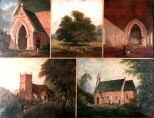
There is a painting by Reuben Bussey dated 1867. With five scenes on one canvas, it shows the mediæval church, the proud architect, the new church and its interior. You'll notice there is also an oak tree in the top central panel, frustratingly the relevance has not been made clear.
Church members today and residents of Bulcote continue to support and to keep the church in good repair. Over the past few years the church has seen a great deal of improvement. Following re-roofing, the heating and lighting were updated to replace the earlier systems installed in the 1940s and, coupled with redecoration, the church provides a warm, welcoming house of worship.
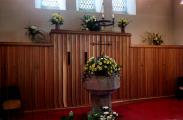
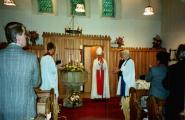
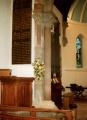
Recognising the essential requirements that make Holy Trinity even more inviting, we have recently undertaken major improvements to our facilities. These include connection to the mains water supply and construction of a lobby, kitchen and loo ("bathroom"). Everyone is extremely impressed with the compassionate way everything has fitted in. In the following photos, the font makes an attractive feature for floral arrangements and Bishop Alan (the Bishop of Sherwood) dedicates the new extension (it was also our Harvest Festival, hence the additional fruit and vegetables).
Thanks to the generous gift of adjacent land, a new pathway has been constructed to provide a clean, dry, well graduated access as an alternative approach from the York stone steps (which can be quite slippery after rain) for church members and visitors in wheelchairs, families with children in prams and pushchairs, or anyone who wants a stroll through the newly landscaped area. It is particularly pleasing that the layout of the new path follows part of the ancient pathway trodden by so many worshippers over the early years.
If anyone reading this has any information regarding Holy Trinity's history, we would be most grateful to hear from you. As displayed in the left hand column, we can be contacted at Church@Bulcote.com.